
YONGFAN HVAC - Premium Header
Engineered HVAC & Industrial Air Systems
YONGFAN HVACYOFAN HVAC Home
Water Treatment Equipment | YONGFAN
Water Quality Engineering · 4 Equipment Families · DN15–DN700

Water Treatment Equipment: Matched to Chemistry, Temperature & Hardness Limits

Water treatment equipment should be selected from water chemistry, system temperature and operating objective; the wrong method can leave scale, solids or hardness essentially unchanged.

Compare YONGFAN inline electronic descaling (JFGP), non-invasive broad-spectrum induction (DN15–DN700), automatic ion-exchange water softeners (RLC), and integrated circulating filtration systems (SGV-PW, KGS, WHQC, ZCPL).

4 Families Electronic · Induction · Softener · Filters
Hardness Limits ≤700 to ≤2,000 mg/L CaCO₃
Softener Output ≤0.03 mmol/L Residual
Temperature Span 2 °C – 120 °C
YONGFAN dynamic ion-group water treatment unit
Water Treatment & Hardness Control Physical Descaling · Ion-Exchange Softening · Automatic Backwash Filtration
01 / System Selection

Water Problems Look Similar But Require Different Treatment Methods

A heat exchanger with rising approach temperature, a scaled boiler, a cooling loop with rust sludge, and hard-water breakthrough cannot be solved by one generic “water-quality” device.
YONGFAN multi-media water filter
Water Quality Chemistry

Separating Scale, Solids, Corrosion, and Hardness

Per ASHRAE Water Treatment fundamentals, mineral scale, suspended solids, electrochemical corrosion, and biofouling require distinct treatment mechanisms.

Physical Descaling vs. Softening

Electronic and induction units alter crystallization behavior physically without removing calcium/magnesium. Boiler makeup requiring residual hardness limits needs RLC ion-exchange softening.

Impact: Boiler scaling & hard water non-compliance

Suspended Solids & Sludge

Electronic conditioning does not remove suspended rust, debris, or magnetite. Suspended solids require automatic backwash filtration (SGV-PW, KGS, WHQC, ZCPL).

Impact: Exchanger channel clogging & sludge accumulation

Operating Temperature Limits

RLC softeners are limited to 2–50 °C feedwater. Inline JFGP handles up to 95 °C, while broad-spectrum induction operates up to <120 °C without pipe cutting.

Impact: Resin breakdown or thermal failure

Retrofit Installation Constraints

When operating plants cannot cut pipes for flanged inline vessels (JFGP), non-invasive external induction coils wrap around existing pipes without shutdown.

Impact: Plant outage costs avoided

Define the Treatment Target Before Selecting Technology

Verified against DOE Industrial Water Guidelines and ASHRAE standards.

01 Total Hardness (mg/L CaCO₃ or mmol/L)
02 Operating Water Temperature (°C)
03 Suspended Solids / Turbidity (NTU)
04 Installation: Inline vs. Non-Invasive
02 / Portfolio Showcase

Water Treatment Portfolio: 4 Equipment Families

From inline high-frequency electronic conditioners and non-invasive induction processors to ion-exchange softeners and integrated backwash filtration.
01 · Inline Electronic Treatment 1 to 2,700 m³/h · DN15–DN600

JFGP Electronic Water Treatment

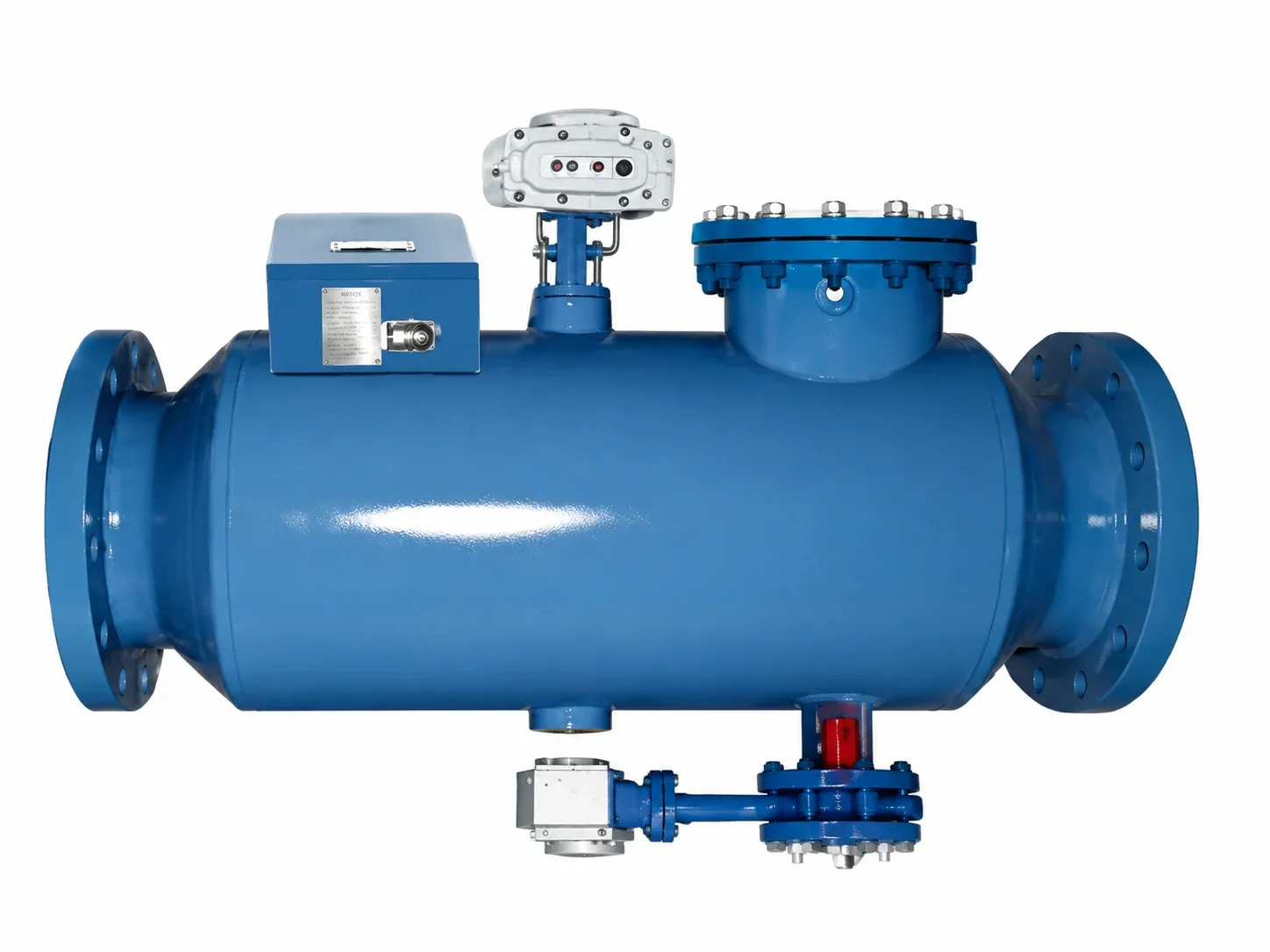
Inline high-frequency electronic water processor featuring 16 standardized sizes. Treatment body in Q235-B, SS304, or SS316L with internal electrodes delivering high-frequency electromagnetic conditioning up to 12 MHz. Operates on water hardness <700 mg/L as CaCO₃ and temperatures ≤95 °C with ≤1.5 m H₂O head loss.

Treatment Flow
1 – 2,700 m³/h (16 sizes)
Max Hardness
<700 mg/L as CaCO₃
Max Water Temp
≤95 °C
Head Loss
≤1.5 m H₂O
Primary Applications

Central chilled-water loops, hot-water boiler circuits, and industrial cooling towers during new builds or planned shutdowns.

02 · Non-Invasive Induction DN15 to DN700 · No Pipe Cutting

Broad-Spectrum Induction Water Treatment

Non-invasive physical conditioning using external induction coils wrapped around existing pipes. STM32 microprocessor controller delivers auto-scanning 10 Hz–500 kHz broad-spectrum field. Handles harder water (up to 2,000 mg/L CaCO₃) and higher temperatures (<120 °C) with zero added pressure drop and zero process outage.

Pipe Diameter
DN15 – DN700
Max Hardness
≤2,000 mg/L as CaCO₃
Max Water Temp
<120 °C
Installation
External coil · Zero shutdown
Primary Applications

Continuous operating plants, industrial circulating cooling towers, high-temp heating lines, geothermal and oilfield water retrofits.

03 · Chemical Hardness Removal Residual Hardness ≤0.03 mmol/L

RLC Fully Automatic Water Softeners

Automatic sodium ion-exchange softening systems featuring resin tanks, automated multi-port control valves, and brine regeneration tanks. Reduces raw water hardness (up to 10.0 mmol/L) down to verified residual hardness ≤0.03 mmol/L for boiler feedwater compliance.

Raw Water Hardness
≤10.0 mmol/L
Residual Hardness
≤0.03 mmol/L (Verified)
Operating Water Temp
2 – 50 °C
Inlet Pressure
0.2 – 0.6 MPa (Turbidity ≤1 NTU)
Primary Applications

Steam boiler makeup, domestic hot-water systems, laundry facilities, and processes requiring guaranteed low residual hardness.

04 · Filtration & Combined Systems SGV-PW · KGS · WHQC · ZCPL

Other Water Treatment Equipment (Filtration & Side-Stream)

Integrated circulating-water cleanup equipment combining physical descaling with automatic backwash filtration and sludge purging. Includes SGV-PW (-20 to 120 °C), KGS integrated systems (≤800 mg/L hardness, 0–85 °C), WHQC full-process systems, and ZCPL side-stream processors (1–3% flow).

Filtration Screen
Stainless steel auto-backwash
Working Pressure
≤1.6 MPa standard
Side-Stream Rate
1 – 3% of circulating flow (ZCPL)
Solids Removal
Sludge purge & particle capture
Primary Applications

Open cooling-water loops, dirty circulating systems, and district hydronic networks carrying rust, debris, and suspended particles.

03 / Selection Routing

Water Treatment Family Comparison Matrix

Cross-reference all four YONGFAN water treatment product families by primary engineering role, published capacity boundary, and first selection input.
Product Family What It Solves Published Range Boundary First Input to Confirm Action
Electronic Water Treatment Inline physical conditioning where pipe cutting is acceptable 1–2,700 m³/h · DN15–DN600 · <700 mg/L · ≤95 °C Peak flow & raw-water hardness Configure JFGP
Induction Water Treatment Non-invasive retrofit physical treatment on existing pipework DN15–DN700 · ≤2,000 mg/L · <120 °C · No shutdown Pipe DN, hardness & outage constraints Configure Induction
Water Softeners Removes calcium and magnesium by sodium ion exchange Raw ≤10.0 mmol/L · Residual ≤0.03 mmol/L · 2–50 °C Required residual hardness limit Configure RLC
Other Water Treatment (Filters) Adds filtration, sludge removal, backwash or side-stream treatment KGS/WHQC/SGV-PW ≤1.6 MPa · ZCPL treats 1–3% side-stream Suspended solids & filtration target Configure Filters
04 / Procurement Protocol

Information Required for Water Treatment Equipment Sizing

A water quality laboratory report is the most essential starting document for selecting water treatment hardware.
STEP 01

Water Lab Analysis

Total hardness (mg/L or mmol/L), TDS/conductivity, pH, and chloride content.

STEP 02

Flow Rate & Pipe DN

Peak treatment flow (m³/h), pipe diameter (DN), and available straight pipe run.

STEP 03

Water Temperature

Normal operating temperature and maximum upset temperature limit (°C).

STEP 04

Treatment Objective

Hardness removal (softener), scale control (electronic), or solids filtration.

Engineering Handoff

Submit Water Analysis for Equipment Recommendation

YONGFAN water treatment engineers will review water chemistry, calculate sizing parameters, and recommend the optimal technology.

Total Hardness (as CaCO₃ or mmol/L)
Peak Water Flow Rate (m³/h)
Operating Water Temperature (°C)
Pipe DN & Pipe Material Grade
Suspended Solids / Turbidity (NTU)
Installation Mode: Inline vs. Non-Invasive
05 / Manufacturing Verification

Electronic Assembly & High-Pot Insulation Testing

Electronic generators, electrodes, and induction coils undergo 5,000 V hi-pot testing, burn-in verification, and pressure checks.
Electrical QA

5,000 V Hi-Pot Testing

Every electrode assembly and coil set receives 5,000 V dielectric insulation testing to ensure zero current leakage.

Burn-in QA

48–72 Hour Soak Test

Electronic controllers and induction signal generators undergo 48–72 hour continuous burn-in testing on test benches.

Frequency QA

Oscilloscope Check

High-frequency output waveforms and scanning sweep ranges are calibrated against laboratory reference oscilloscopes.

Pressure QA

1.5× Hydrostatic Test

Inline treatment bodies and filter vessels tested at 1.5× design pressure to GB 150 pressure vessel standards.

Stock & Lead Time: Standard JFGP/Induction sizes stocked for 7–15 day delivery; custom systems 15–25 working days. Trade Terms: EXW, FOB, CIF, CFR, and DDP export logistics supported globally.
06 / Engineering Knowledge

Water Treatment Equipment FAQ

Direct engineering answers regarding chemical softening vs. physical descaling, non-invasive induction, and filtration.

Which family should I choose for verified hardness removal?

Use Water Softeners (RLC). RLC uses ion-exchange resin to chemically remove calcium and magnesium, guaranteeing residual hardness ≤0.03 mmol/L.

Which product fits a retrofit where the pipe cannot be cut?

Start with Induction Water Treatment. Its broad-spectrum signal coils wrap around the outside of existing pipes without plant shutdown.

When does JFGP make more sense?

Use Electronic Water Treatment (JFGP) where an inline flanged vessel is acceptable, peak flow is within standard ratings, and hardness is <700 mg/L.

What should I use when suspended solids are the main problem?

Review Other Water Treatment Equipment, specifically SGV-PW, KGS, WHQC, or ZCPL units that incorporate stainless filter screens and backwashing.

Which family handles the highest water hardness in electronic mode?

Induction Water Treatment handles up to 2,000 mg/L as CaCO₃, compared to <700 mg/L for JFGP. Above 2,000 mg/L, softening is recommended.

What information should I provide before selection?

Submit water analysis (hardness, TDS, pH, chlorides), flow rate, pipe DN, water temperature, pressure, and the desired outcome (softening vs descaling).

07 / Application Boundaries

Water Treatment Engineering Boundaries

Understanding technology boundaries before committing to procurement.
Boundary 01 / Chemistry Limits

No Chemical Removal

Electronic and induction units do not remove dissolved calcium/magnesium; use RLC softeners when residual limits are mandated.

Boundary 02 / Temperature Limit

Softener 2–50 °C

Do not feed water above 50 °C into ion-exchange softeners; use high-temp electronic or induction units for hot water.

Boundary 03 / Filtration Scope

Filters for Solids

Do not rely on electronic descalers to remove suspended rust or sludge; combine with automatic backwash filter screens.

Boundary 04 / Open Cooling Loops

Blowdown Still Needed

Physical treatment in cooling towers does not eliminate the need for blowdown to control mineral concentration cycles.

08 / Engineering Handoff

Select the Right Water Treatment System for Your Plant

Send your water analysis report, system flow rate, pipe size, and operating temperature. YONGFAN application engineers will verify hardness boundaries, recommend the right treatment family, and provide submittal drawings.

Flow: 1–2,700 m³/h Pipe: DN15–DN700 Hardness: ≤700 to ≤2,000 mg/L Softening: ≤0.03 mmol/L Residual 5,000 V Hi-Pot Tested GB/T 3133 & GB 150 Compliant
YONGFAN ambient-temperature filtration deaerator
Direct Application Engineering Support
Water chemistry analysis, treatment sizing & certified GA drawings.