
YONGFAN HVAC - Premium Header
Engineered HVAC & Industrial Air Systems
YONGFAN HVACYOFAN HVAC Home
Air Volume Control Dampers | YONGFAN
JG/T 436-2014 · Manual, Electric & Passive Control Functions

Air Volume Control Dampers: Balancing, Mixing & Flow Control

Air volume control dampers regulate branch flow, mixing, relief and backflow; the wrong blade motion or actuator can make balancing unstable and increase system pressure loss.

YONGFAN manufactures a complete series of airflow control dampers under JG/T 436-2014, including manual and motorized butterfly dampers, opposed-blade (DK) mixing dampers, passive constant-air-volume valves (F-DL), residual-pressure relief valves (F-YY), non-return check valves (F-ZH), and slide-gate dampers.

Governing CodeJG/T 436-2014
Blade MotionOpposed (DK) · Parallel · Butterfly
Drive ModesManual (SD) · Electric (D) · Pneumatic (QD)
Special DutiesConstant-Volume (DL) · Relief (YY) · Check (ZH)
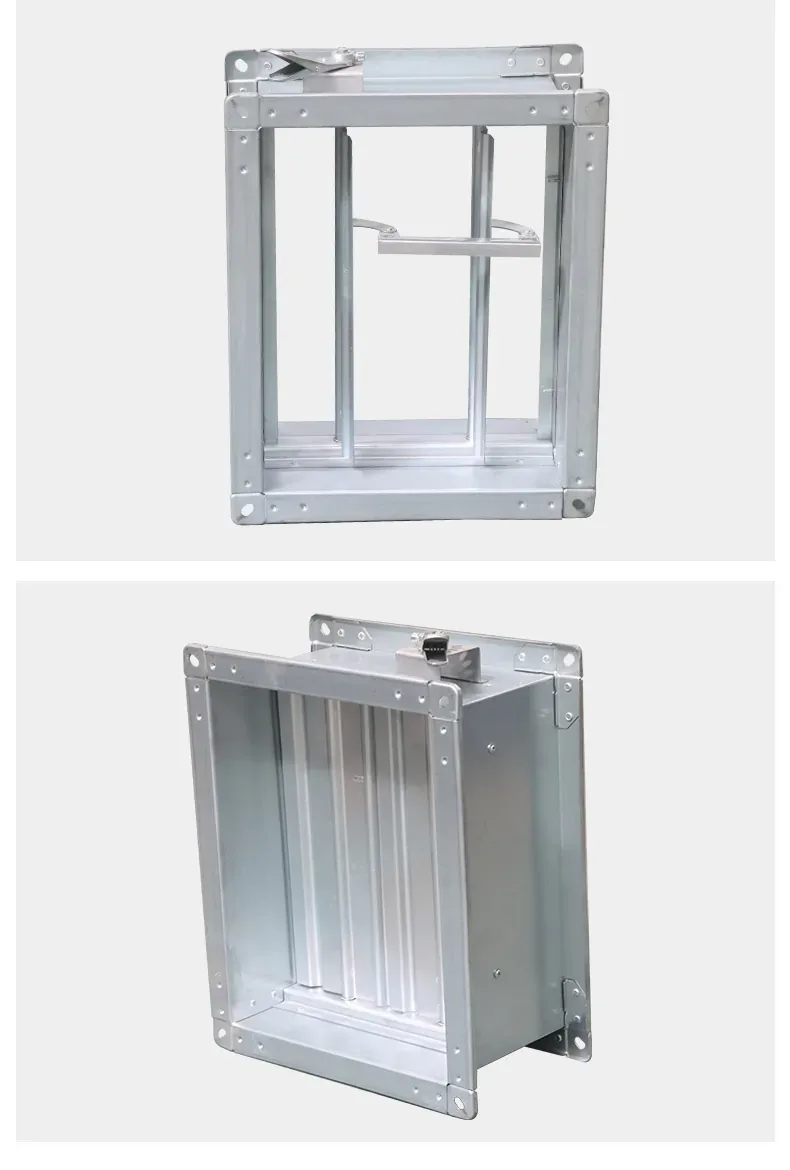
YONGFAN manual air-volume control damper
Air Volume Control Series JG/T 436-2014 · Opposed-Blade Modulation · Passive Constant-Flow Control
01 / Flow Balancing Risks

Airflow-Control Problems Often Begin With the Wrong Damper Function

A branch duct is short of air during commissioning; opening one damper starves another, causing cyclical adjustments when the wrong blade motion or actuator type is chosen.

A manual butterfly damper provides simple throttling, but it does not behave like an opposed-blade damper in a modulating application. A passive constant-air-volume valve does something different again: it changes blade position mechanically as duct pressure shifts so airflow stays constant without external power.

Backflow and room-pressure control create separate requirements: a check valve should open with forward flow and close when the fan stops, while a relief valve opens only after room differential exceeds its preset value.

Actuator choice is critical: an on-off electric actuator cannot modulate intermediate blade angles. If continuous modulation is expected, a regulating modulating actuator (0–10V / 4–20mA) is required.

YONGFAN manual control damper product set

ANSI/AMCA Standard 500-D establishes laboratory methods for damper pressure drop, air leakage, operational torque and rating characteristics. ASHRAE distinguishes parallel- and opposed-blade dampers for modulating control.

Butterfly vs Opposed-Blade

Butterfly blades provide simple on/off throttling; opposed blades (DK) ensure smooth, distributed modulation across the full actuator stroke.

Linear Authority · DK Code

Passive Constant Flow

F-DL valves maintain constant airflow mechanically using aerodynamic pressure against internal springs and cams — zero electrical wiring.

F-DL Constant Flow · No Power

One-Way & Pressure Relief

F-YY relieves positive room pressure; F-ZH prevents backflow when the fan stops (8–15 m/s forward duct velocity).

F-YY Relief · F-ZH Check Valve
02 / Model Coding Structure

Function Codes Describe What the Damper Is Expected to Do

YONGFAN organizes the series under JG/T 436-2014, encoding function, drive mode, blade motion, and leakage grade into a standardized model string.
1. Function Code

Special Purpose

YY: Residual-pressure relief valve.
ZH: Check valve.
DL: Constant air-volume valve.
GW: High-temperature valve.
(No code = general volume control)

YY / ZH / DL / GW
2. Drive Code

Actuation Mode

SD: Manual handwheel.
D: Electric actuator (on/off or modulating).
QD: Pneumatic actuator.

SD / D / QD
3. Blade Motion

Kinematic Coupling

DK: Opposed-blade motion.
P: Parallel-blade motion.
(No code = single butterfly blade)

DK / P / Butterfly
4. Leakage Code

Airtightness Grade

LX: Zero-leakage.
GM: High-airtightness.
ZM: Medium-airtightness.
DM: Low-airtightness.

LX / GM / ZM / DM

Model Decoding Example: F-SD-DT(1)-GM-DK-φ400 describes a manual (SD), single-body (DT), high-airtightness (GM), opposed-blade (DK) circular damper with Ø400 mm diameter.

03 / Product Lineup

Five Control Levels and Damper Configurations

Detailed technical features across butterfly, opposed-blade, constant-volume F-DL, relief F-YY, check F-ZH, and slide-gate valves.
Configuration 01 · Simple Throttling F-SD-DT(1)-W×H · F-D-DT(1)-W×H

Manual and Electric Butterfly Dampers

Single-blade compact construction installed directly in ductwork for basic branch balancing or two-position isolation.

Manual ButterflyF-SD-DT(1)-W×H · Direct hand-lever or worm gear setting
Electric ButterflyF-D-DT(1)-W×H · Electric on-off or modulating actuator
MaterialsEnamel-baked steel plate, hot-dip galvanized sheet, 304/316L SS
Best FitStraightforward branch throttling where multiblade action is unneeded
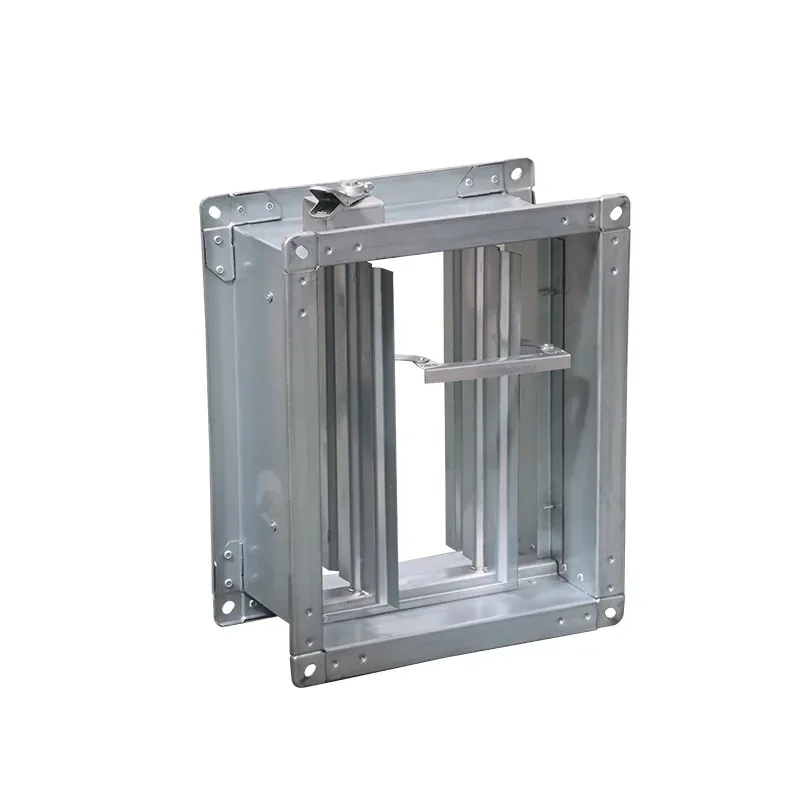
YONGFAN manual air-volume control damper
Butterfly Series Single Blade Throttling · Direct Duct Installation · Manual & Motorized
Configuration 02 · Linear Balancing & Mixing F-SD-DT(1)-DK-W×H · F-D-DT(1)-DK-W×H

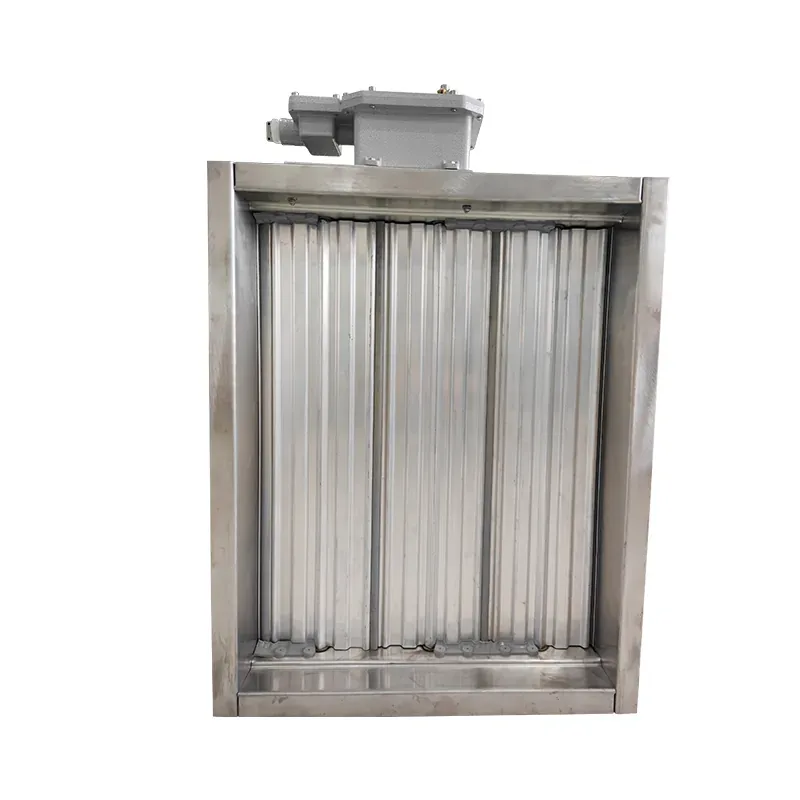
Opposed-Blade Control Dampers (DK)

Multiple interlinked blades rotating in opposite directions. Provides distributed restriction across the entire face opening, ensuring linear control authority for fresh-air / return-air mixing and modulating loops.

Manual Opposed (DK)Handwheel with clockwise-close linkage mechanism
Electric Opposed (DK)Modulating 0–10V / 4–20mA or floating actuator options
Air MixingIdeal for AHU fresh/return air economizer mixing plenums
Aerodynamic StabilityEven velocity profile prevents turbulence and localized duct noise
YONGFAN motorized airtight ventilation damper
Opposed-Blade (DK) Series Linear Modulating Authority · Fresh/Return Mixing · Multi-Blade Linkage
Configuration 03 · Mechanical Passive Flow Stabilization F-DL-W×H · Zero Power Required

F-DL Constant Air-Volume Valve

Operates entirely without external power. Aerodynamic duct pressure acts against internal blades, precision springs and a cam mechanism, automatically adjusting the blade opening as upstream static pressure fluctuates.

No Power NeededSelf-acting mechanical blade/spring/cam stabilization
Constant VolumeHolds branch flow rate within designed static pressure band
Lower Installation CostZero electrical wiring, DDC controllers or sensors required
Application ScopeToilet exhaust, hotel room fresh air, lab baseline extract
YONGFAN manual air-volume control damper
F-DL Constant Flow Series Self-Regulating Mechanical Spring-Cam · Zero Wiring · Stable Branch Airflow
Configuration 04 · Specialized Protection & Backflow F-YY Relief · F-ZH Check · Slide-Gate

Relief (F-YY), Check (F-ZH) & Slide-Gate Valves

Dedicated non-return, differential relief, and low-resistance knife gate solutions for specialized ventilation systems.

F-YY Relief ValveCounterweighted blade opens to ~45° when room positive pressure exceeds setpoint
F-ZH Check ValvePrevents backflow when fan stops; rated for 8–15 m/s forward duct velocity
Slide-Gate ValveKnife-blade rectangular (F-W×H) and circular (F-φD) for compact shutoff
Cleanrooms & LabsPositive pressure cascade control and fan discharge reverse-flow prevention
YONGFAN manual control damper product set
Specialized Airflow Series F-YY Positive Relief · F-ZH Reverse Flow Prevention · Slide-Gate Isolation
04 / Specification Matrix

Air Volume Control Damper Specifications

Technical parameter comparison across all YONGFAN air-volume-control configurations.
Configuration Supplier Model Primary Function Key Performance Boundary
Manual butterfly
F-SD-DT(1)-W×H
Manual branch throttling Rectangular; direct duct installation
Electric butterfly
F-D-DT(1)-W×H
Remote on-off or regulating control Electric actuator; on-off/regulating options
Manual opposed-blade
F-SD-DT(1)-DK-W×H
Branch balancing and fresh/return-air mixing Opposed blades; manual handwheel
Electric opposed-blade
F-D-DT(1)-DK-W×H
Remote branch/mixing control Electric actuator; on-off/regulating options
Constant air-volume
F-DL-W×H
Passive constant-flow control No external power; blade/spring/cam mechanism
Residual-pressure relief
F-YY-W×H
Positive-pressure relief Counterweighted blade; opens above set differential
Check valve
F-ZH-DT(1)-P-W×H
Prevent reverse airflow Documented normal duct velocity 8–15 m/s
Slide-gate
F-W×H / F-φD
Compact isolation Rectangular or circular knife-blade profile
05 / Procurement Protocol

What Information Is Needed for Volume Damper Selection?

Essential inputs to confirm before ordering volume dampers, ensuring proper actuator torque and flow authority.
Damper Sizing Checklist

Key Sizing Parameters

Submitting your design airflow, face velocity, control mode (manual vs modulating), and leakage requirements enables our application team to configure the ideal damper model.

1. Branch Design Airflow (m³/h / CFM)
2. Duct Velocity & Face Velocity (m/s)
3. Function: Balancing, Mixing, Constant-Flow or Relief
4. Blade Motion: Butterfly vs Opposed-Blade (DK)
5. Drive: Manual Handwheel vs Electric Modulating
6. Electric Actuator Signal: On-Off vs 0–10V / 4–20mA
7. Physical Duct Dimensions (Rectangular W×H / ØD)
8. Material: Enamel Steel, Galvanized Sheet, Stainless
06 / Compliance & Standards

JG/T 436-2014 Standard Scope and Production Controls

Air volume control valves manufactured in accordance with Chinese building ventilation standard JG/T 436-2014.
Execution Standard

JG/T 436-2014 Standard

The series is classified and fabricated according to JG/T 436-2014 for building ventilation air volume control valves.

Blade Motion

DK Opposed Linkage Assembly

Precision nylon and bronze gear bushings ensure low operating torque and smooth multi-blade synchronous rotation.

Project Verification

Dimensional Inspection

Factory flange dimensions, actuator mounting plates, and manual handwheel self-locking mechanisms checked before packing.

Disclosure: JG/T 436-2014 is the documented manufacturing standard. For international projects requiring AMCA 500-D certified ratings, request verified laboratory test reports.
07 / Architectural Boundaries

General Control Dampers Are Not Fire, Ex or Insulated Dampers

Use this family for ordinary balancing, mixing, passive constant flow, relief and backflow. Do not compromise specialized duties.

Fire Boundary Penetrations

If the duct crosses a fire compartment wall, use documented FHF (70 °C), PFHF (280 °C), or PYF fire and smoke dampers.

Fire Compartment Boundary

Cold-Air & Anti-Condensation

If cold air creates condensation sweating risks, specify the insulated F-BW family with EPDM seals rather than uninsulated sheet metal.

F-BW Insulated Required

Zone VAV vs Passive F-DL

If the zone requires pressure-independent minimum/maximum airflow scheduling and BMS modulation, use a VAV terminal rather than passive F-DL.

VAV Terminal Routing
ALERTS — NOT PART OF THE PAGE. RESOLVE BEFORE PUBLISHING.
The source assigns model F-SD-DT(1)-DM-DK-W×H to both “Sealed Butterfly Valve” and “Opposed-Blade Sealed Valve.” DK is defined as opposed-blade, so the sealed-butterfly model code appears inconsistent and must be verified.
The source lists leakage grades LX, GM, ZM and DM but provides no numerical leakage limits for the general air-volume-control family. Do not publish quantitative airtightness claims without test data.
The source lists a GW high-temperature valve classification but provides no detailed GW model, temperature range or performance data in the retrieved product section.
Supplier credibility evidence is insufficient for the required five-part audit: manufacturing location, batch testing, application laboratory and family-specific supply-continuity data are not documented.
08 / Technical Q&A

Air Volume Control Dampers Frequently Asked Questions

Direct answers on manual vs opposed blade dampers, constant volume F-DL, relief valves, check valves, and leakage classifications.

Which YONGFAN damper should I use for manual branch balancing?

Use the F-SD-DT(1)-W×H butterfly damper for simple throttling, or the F-SD-DT(1)-DK-W×H opposed-blade damper where multiblade control better suits the branch or mixing duty.

Which family supports electric modulation?

The F-D-DT(1)-W×H electric butterfly and F-D-DT(1)-DK-W×H electric opposed-blade configurations are documented with on-off or regulating actuator functions.

Which damper keeps airflow constant without electrical power?

Use the F-DL-W×H Constant Air-Volume Valve. It uses duct pressure difference, blades, springs and a cam to adjust the opening mechanically.

Which product maintains positive room pressure?

Use the F-YY-W×H Residual-Pressure Relief Valve. It opens in one direction when differential pressure exceeds its set level.

Which valve prevents airflow reversal after the fan stops?

Use the F-ZH-DT(1)-P-W×H Check Valve. YONGFAN documents it for normal duct velocities of 8–15 m/s.

Which product should I use for fresh-air and return-air mixing?

Start with the opposed-blade control damper, manual or electric. YONGFAN specifically identifies this family for branch regulation and fresh/return-air mixing.

Does YONGFAN provide defined leakage grades?

Yes. The source identifies LX, GM, ZM and DM airtightness categories, but it does not provide numeric general-family leakage limits in the retrieved pages.

Is the F-DL constant-volume valve the same as a VAV terminal?

No. F-DL is a passive mechanical constant-air-volume device. YFVAV-S-T100 is a pressure-independent controlled VAV terminal with airflow sensing and a much broader zone-control function.

09 / Application Engineering Handoff

Select an Air Volume Control Damper

Connect function, blade motion, actuator behavior, leakage requirement, and pressure conditions into one confirmed configuration. Send your branch airflow schedules to our application engineers.

Butterfly Throttling Opposed-Blade DK F-DL Constant Air Volume F-YY Pressure Relief F-ZH Check Valve (8–15 m/s) Slide-Gate Isolation Manual · Electric · Pneumatic
YONGFAN application engineers reviewing damper submittals
Direct Technical Selection Support
Actuator torque sizing, pressure loss calculations, and dimensioned CAD drawings.