YONGFAN HVAC - Premium Header
Engineered HVAC & Industrial Air Systems
YONGFAN HVACYOFAN HVAC Home
Activated Carbon Air Filters | YONGFAN
Molecular & Gas-Phase Adsorption (ISO 10121-1 · ISO 10121-2 · VOCs / Odor)

Activated Carbon Air Filters: Adsorption Mass, Contact Time & Bed Life

Selecting activated carbon by filter shape alone can produce early breakthrough, excessive pressure drop, or poor removal because gas type, contact time and media mass control performance.

Compare YONGFAN refillable HT canister banks (1.7/2.6 kg carbon drums), compact V-type modules (0.18–0.035 s contact time), rigid HTD high-airflow filters (1,600–3,200 m³/h), and shallow odor panels across virgin and chemically impregnated adsorbents.

4 Core Families HT Canister · V-Type · HTD · Panel
Airflow Boundary 85 m³/h (Drum) – 3,740 m³/h (V-Bank)
Media Mass 1.7/2.6 kg Canisters · 7.3 m² HTD
Operating Limit ≤50 °C · Max 70–90% RH
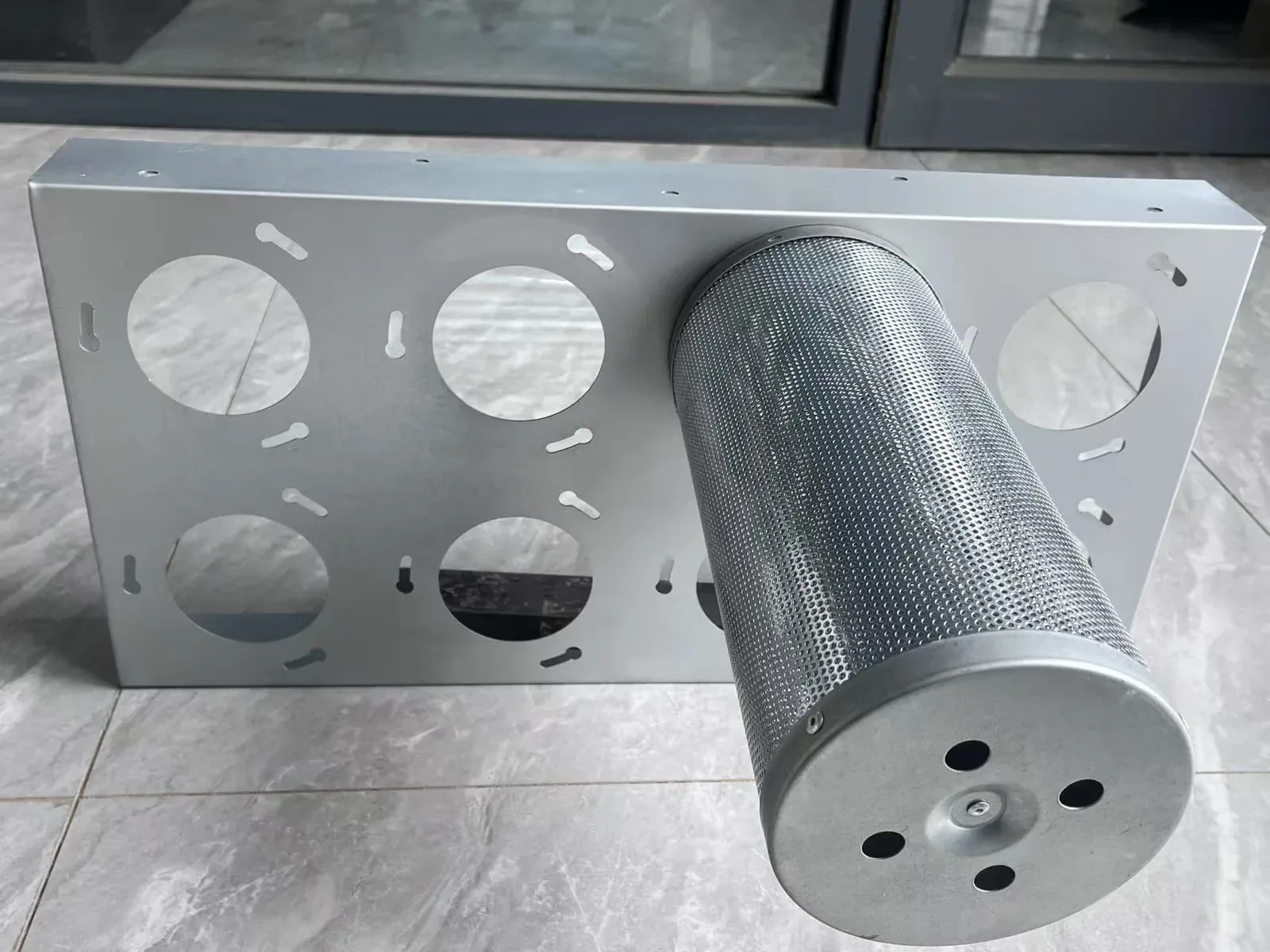
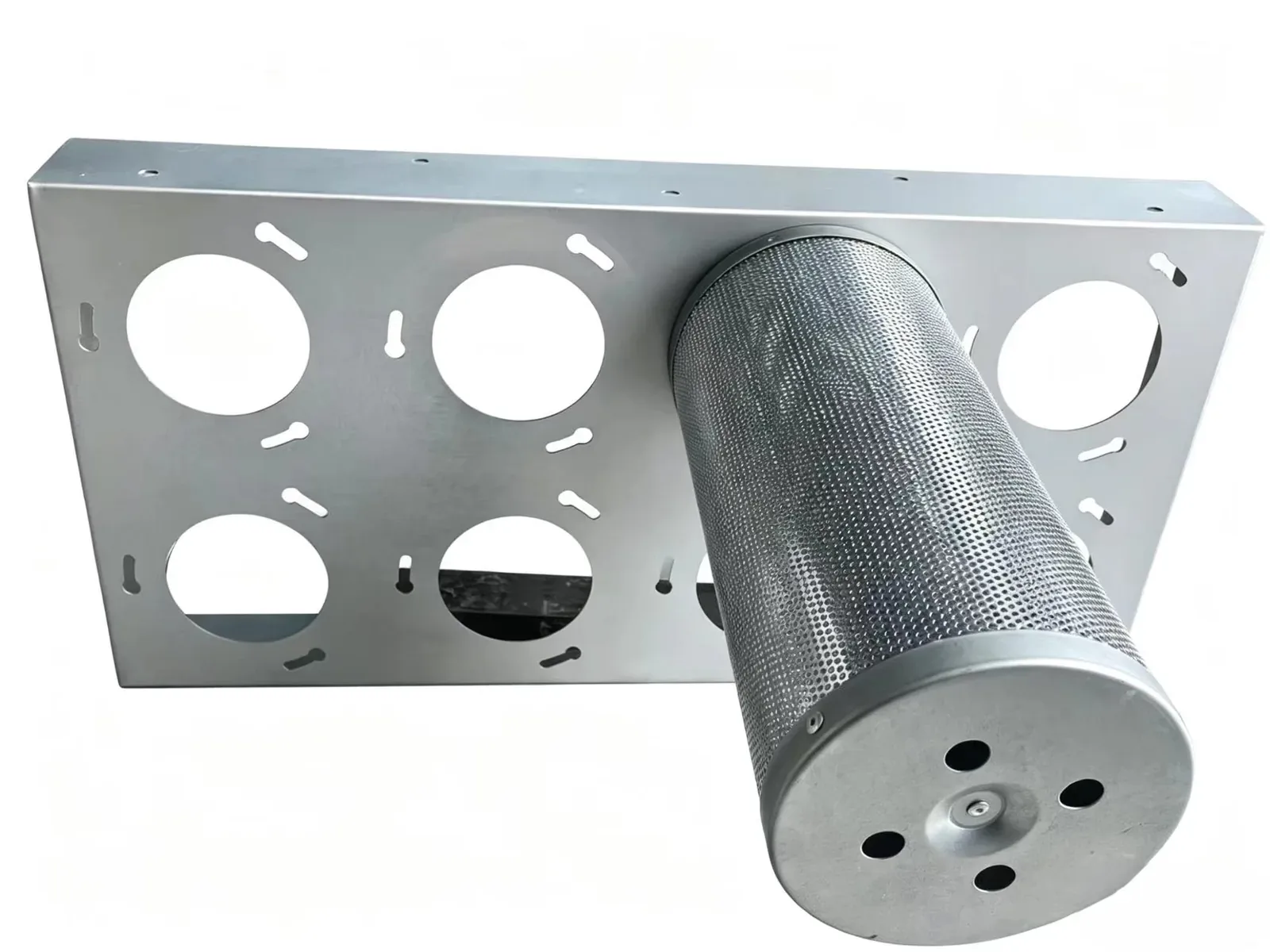
YONGFAN activated-carbon canister holding frame
Molecular Gas-Phase Engineering Gas Breakthrough Dynamics, CTC Adsorption & Residence Time Management
01 / Failure Mechanisms

Activated Carbon Failures Begin Before the Filter Looks Dirty

The AHU is inspected: the carbon filter looks clean, and differential pressure has barely changed, yet offensive odors or toxic gases return. Molecular breakthrough occurs when microporous adsorption sites saturate.
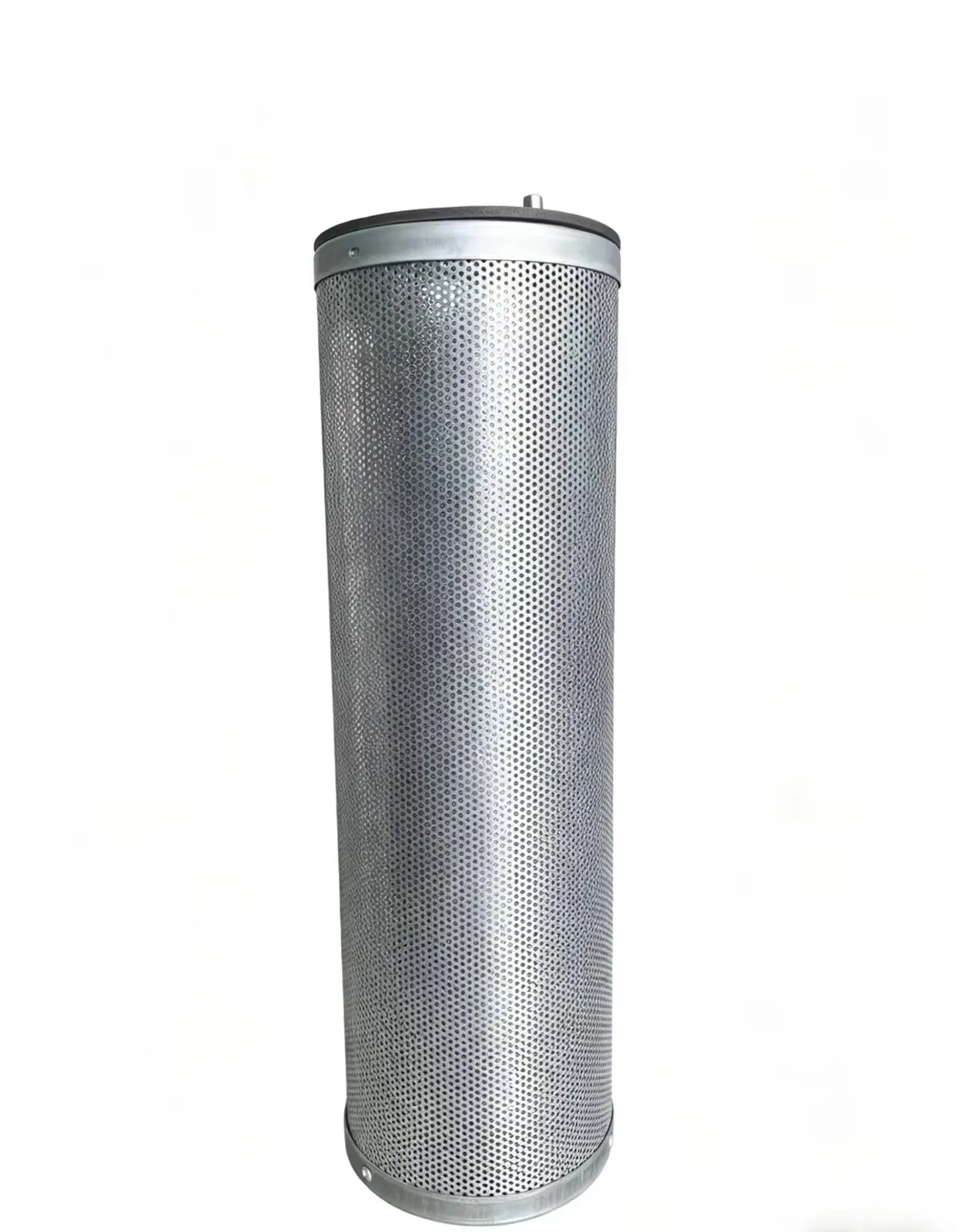
YONGFAN activated-carbon cylindrical canister
Adsorption Physics

Why Pressure Drop Does Not Indicate Saturation

Per US EPA carbon adsorber guidance, gas molecules transfer into carbon pores with finite capacity, requiring scheduled replacement or refill based on exposure hours rather than dust resistance.

Invisible Adsorptive Breakthrough

When microporous internal carbon sites become saturated, gaseous contaminant passes straight through even while differential pressure remains perfectly normal.

Impact: Odor recurrence & indoor air quality complaints

Relative Humidity Pore Competition

Water vapor competes directly for adsorption sites at >70% RH, drastically displacing captured VOCs and cutting organic vapor adsorption capacity.

Impact: Rapid capacity loss under humid ambient air

Inadequate Residence Contact Time

Pushing excessive face velocity through a shallow bed reduces gas contact time below 0.035 s, allowing fast-moving molecules to bypass uncaptured.

Impact: Drastic drop in single-pass removal efficiency

Media Chemistry Mismatch

Standard physical virgin carbon poorly retains polar acidic gases (H₂S, SO₂) or basic amines (NH₃) without specialized chemical impregnation.

Impact: Failure to control target corrosive/toxic gases

Four Engineering Variables Govern Gas-Phase Filtration

Effective molecular control balances contaminant chemistry, total carbon bed mass, gas residence time, and humidity limits.

01 Target Gas Chemistry (VOCs vs Acid/Alkali)
02 Total Adsorbent Bed Mass (kg of Carbon)
03 Residence Contact Time (0.035 to 0.18 s)
04 Maintenance Strategy (Refillable vs Module)
02 / Technical Parameters

Media Mass, Contact Time and Operating Boundaries

Gas-phase adsorption is governed by ISO 10121-1 (media tests) and ISO 10121-2 (device tests) rather than particulate standards.
Parameter 01 / Adsorption Type

Media & Impregnation Type

Virgin activated carbon handles general odors and VOCs via physical adsorption. Chemically modified carbons (KI, KOH, phosphoric acid) target hydrogen sulfide (H₂S), sulfur dioxide (SO₂), ammonia (NH₃), and ozone.

Parameter 02 / Residence Kinetics

Contact Time vs. Velocity

Contact time falls from 0.18–0.16 seconds at lower face velocity (0.5 m/s) to 0.035 seconds at high airflow (2.5 m/s). Higher velocity reduces gas contact opportunity per cubic meter of air.

Parameter 03 / System ΔP

Pressure Drop & Environment

Initial resistance spans 25–40 Pa (shallow panels) to 120 Pa (rigid HTD modules). Operating temperature is rated up to 50 °C (max 60 °C), with strict humidity thresholds of 70%–90% RH.

Activated Carbon Family Engineering Comparison

Published performance boundaries from YONGFAN carbon-filtration engineering files.

ISO 10121 · CTC/Iodine Reference
HT Canisters (17/26)
1.7 / 2.6 kg
Refillable drums · 85/150 m³/h · 80–82 Pa · 70% RH
V-Type GI Module
0.16–0.035 s
Contact time · 700–3,600 m³/h · 25–140 Pa · Archives
HTD High-Airflow
3,200 m³/h
HTD-A (7.3 m²) · 120 Pa Initial · ≤450 Pa Final · 90% RH
Carbon Panel
25–40 Pa
Shallow rack · Odor control · Perforated galvanized frame
03 / Product Lineup

Activated Carbon Families by Airflow & Maintenance Method

YONGFAN supplies four dedicated carbon product routes: refillable loose-media canister banks, extended-contact V-banks, rigid high-airflow modules, and thin odor panels.
Family 01 · HT Series Refillable Loose Media · Modular Drums

HT Activated Carbon Canister Filter

The HT Activated Carbon Canister Filter is the most service-friendly and sustainable gas-phase route. Instead of discarding complete housings, granular activated carbon is housed in cylindrical perforated canisters mounted to a reusable heavy-gauge fixing frame.

Two canister depths are documented: HTG-1-17 / HT-2-17 (142×250 mm, 1.7 kg carbon, 85 m³/h @ ~82 Pa) and HTG-2-26 / HT-2-26 (142×450 mm, 2.6 kg carbon, 150 m³/h @ ~80 Pa). Modular holding frames accommodate 4, 8, 12, or 16 canisters (up to 610×610 mm face size).

Canister Carbon Mass
1.7 kg (250 mm) · 2.6 kg (450 mm)
Airflow per Drum
85 m³/h (17 Series) · 150 m³/h (26 Series)
Frame Canister Layouts
4 Drums (305×305) to 16 Drums (610×610 mm)
Operating Limits
≤50 °C · Maximum 70% Relative Humidity
Sustainability Advantage: Canisters can be emptied, refilled with virgin or custom chemically impregnated carbon, and resealed on site, drastically cutting ongoing operational consumables waste.
YONGFAN high-airflow activated-carbon particle filter
HT Refillable Carbon Canister Bank
Key Applications:
  • Heavy industrial return-air odor control
  • VOC adsorption with replaceable loose media
  • Long-life serviceable AHU carbon banks
  • Impregnated media for specific chemical gases
Family 02 · V-Type Series Extended Contact · Compact Face

V-Type Activated Carbon Filter

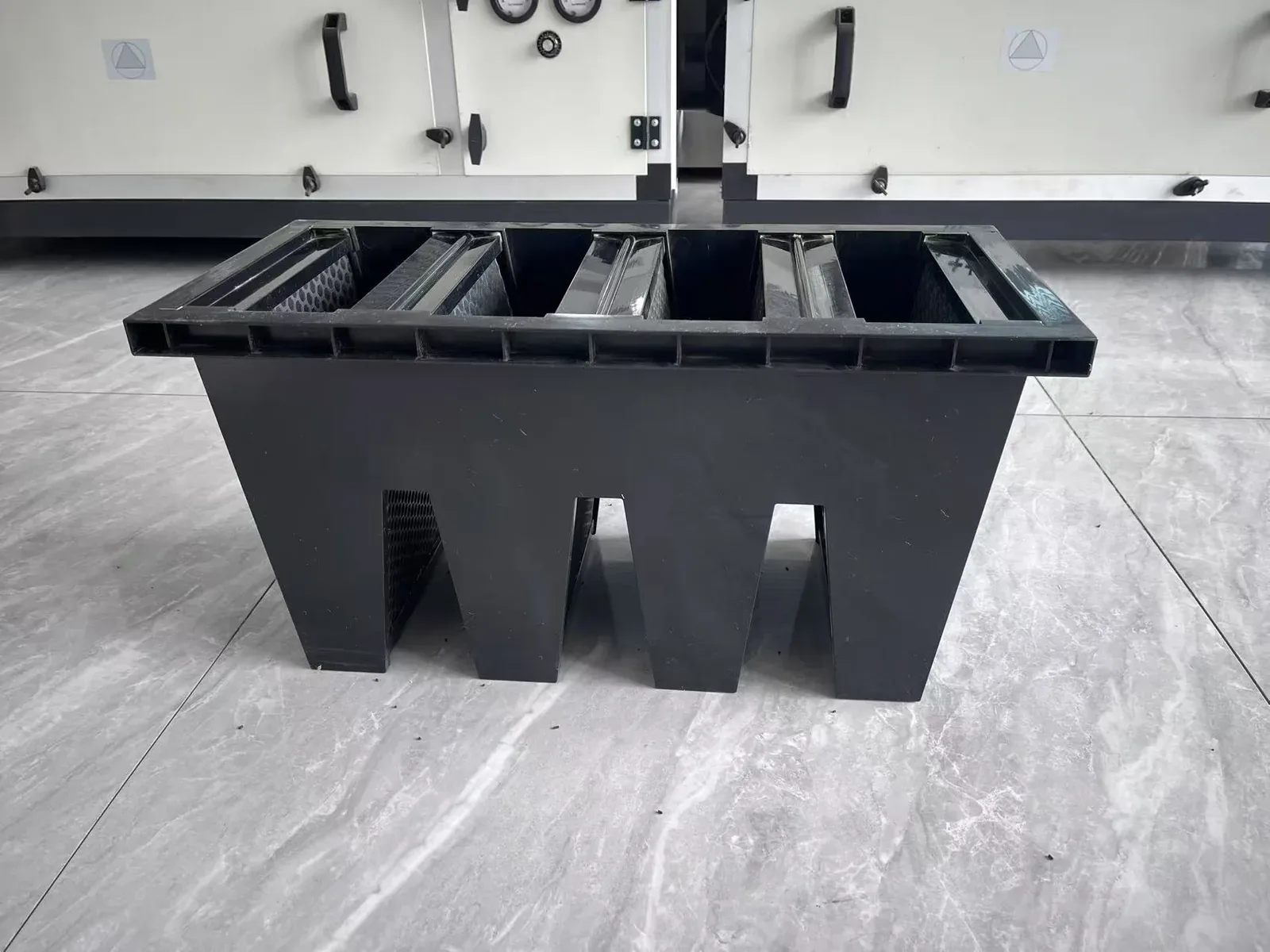
The V-Type Activated Carbon Filter packages deep pleated carbon media in a rigid multi-V arrangement. It provides substantial contact time and media volume inside a compact external footprint.

Available in galvanized-steel (295×290×292 mm, 700–3,600 m³/h, 25–140 Pa, 0.16–0.035 s contact time) and molded-plastic (600×145×440 mm, 1,360–3,740 m³/h, 40–125 Pa, 0.18–0.065 s contact time) versions. Specifically specified for museums, archives, rare collections, and commercial HVAC requiring high residence times.

Contact Time Range
0.16–0.035 s (Galv) · 0.18–0.065 s (Plastic)
Airflow Capacity
700 – 3,600 m³/h (Galv) · Up to 3,740 m³/h (Plastic)
Initial ΔP
25 – 140 Pa (Varies with face velocity)
Target Duty
Museums, Archives, Valuable Collections, Clean Rooms
Face Velocity Caution: Contact time is inversely proportional to airflow velocity. For critical archival preservation, design closer to 0.5–1.0 m/s face velocity to maximize contaminant adsorption.
YONGFAN honeycomb panel activated-carbon filter
V-Bank High-Contact Carbon Module
Preservation Duty:
  • Controls trace VOCs and organic acids in archives
  • Long residence time without bulky drum housings
  • Rigid plastic / galvanized housing prevents bypass
  • Fits standard 292 mm HVAC filter sections
Family 03 · HTD Series 1,600–3,200 m³/h · Molded Rigid Frame

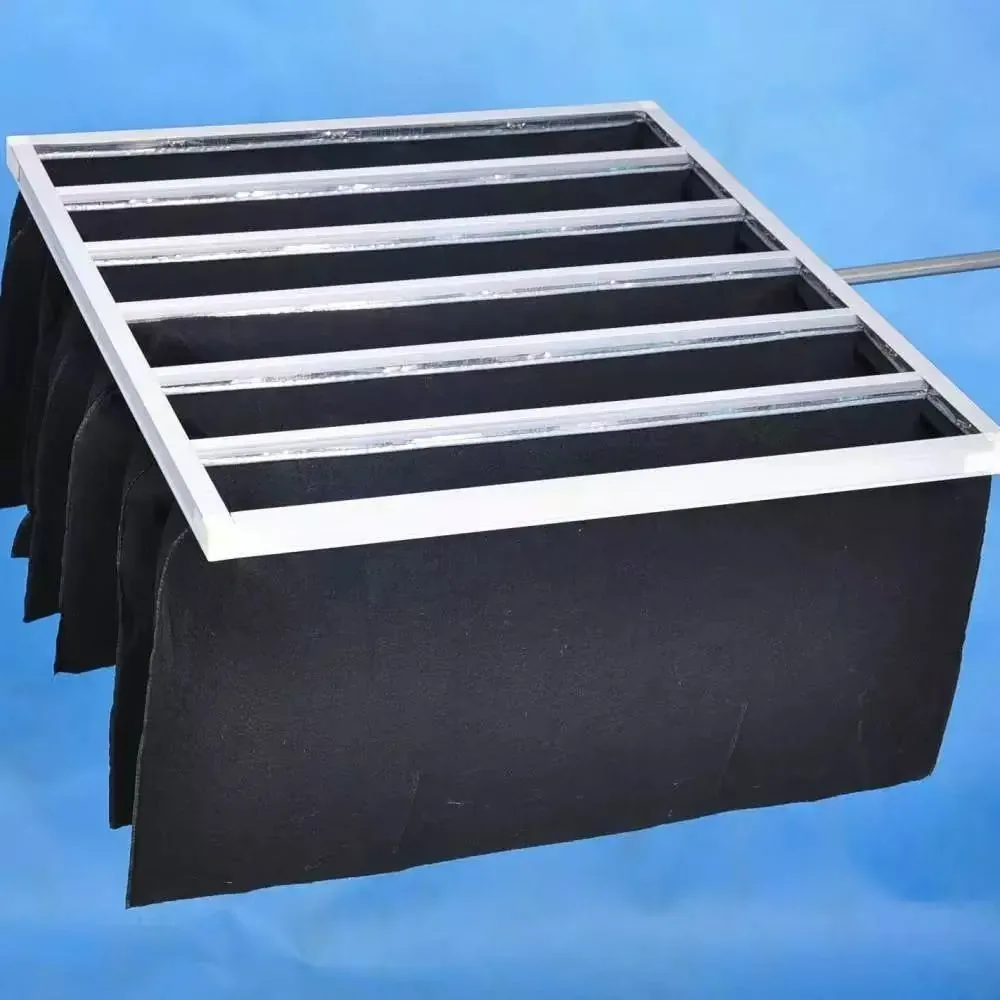
HTD High-Airflow Activated Carbon Filter

The HTD High-Airflow Activated Carbon Filter is YONGFAN’s dedicated modular solution for high-capacity general ventilation air banks. Engineered in rigid molded-plastic frames with up to 7.3 m² of carbon media pack.

Documented in three standard model sizes: HTD-A (592×592×292 mm, 3,200 m³/h, 7.3 m²), HTD-B (592×490×292 mm, 2,400 m³/h, 4.7 m²), and HTD-C (592×287×292 mm, 1,600 m³/h, 3.5 m²). Initial clean resistance is 120 Pa, with recommended replacement at ≤450 Pa (max 600 Pa) and up to 90% RH operating tolerance.

Standard Ratings
3,200 m³/h (HTD-A) · 2,400 m³/h (HTD-B) · 1,600 m³/h (HTD-C)
Initial ΔP
120 Pa Initial Clean Resistance
Final ΔP Limit
≤450 Pa Recommended (≤600 Pa Maximum)
Media Area
Up to 7.3 m² (HTD-A Full Size)
Replacement Threshold: The maintenance team should plan replacement before reaching the absolute 600 Pa limit to prevent fan static stalling and airflow decay.
YONGFAN pocket-type activated-carbon filter
HTD-A 3,200 m³/h High-Airflow Carbon Filter
High-Flow Features:
  • Rigid 592×592×292 mm standard ventilation envelope
  • Direct drop-in replacement for standard 12″ filter tracks
  • Operating temp up to 50 °C (max 60 °C) and 90% RH
  • Complete single-element replacement design
Family 04 · Panel Series Low ΔP (25–40 Pa) · Shallow Track

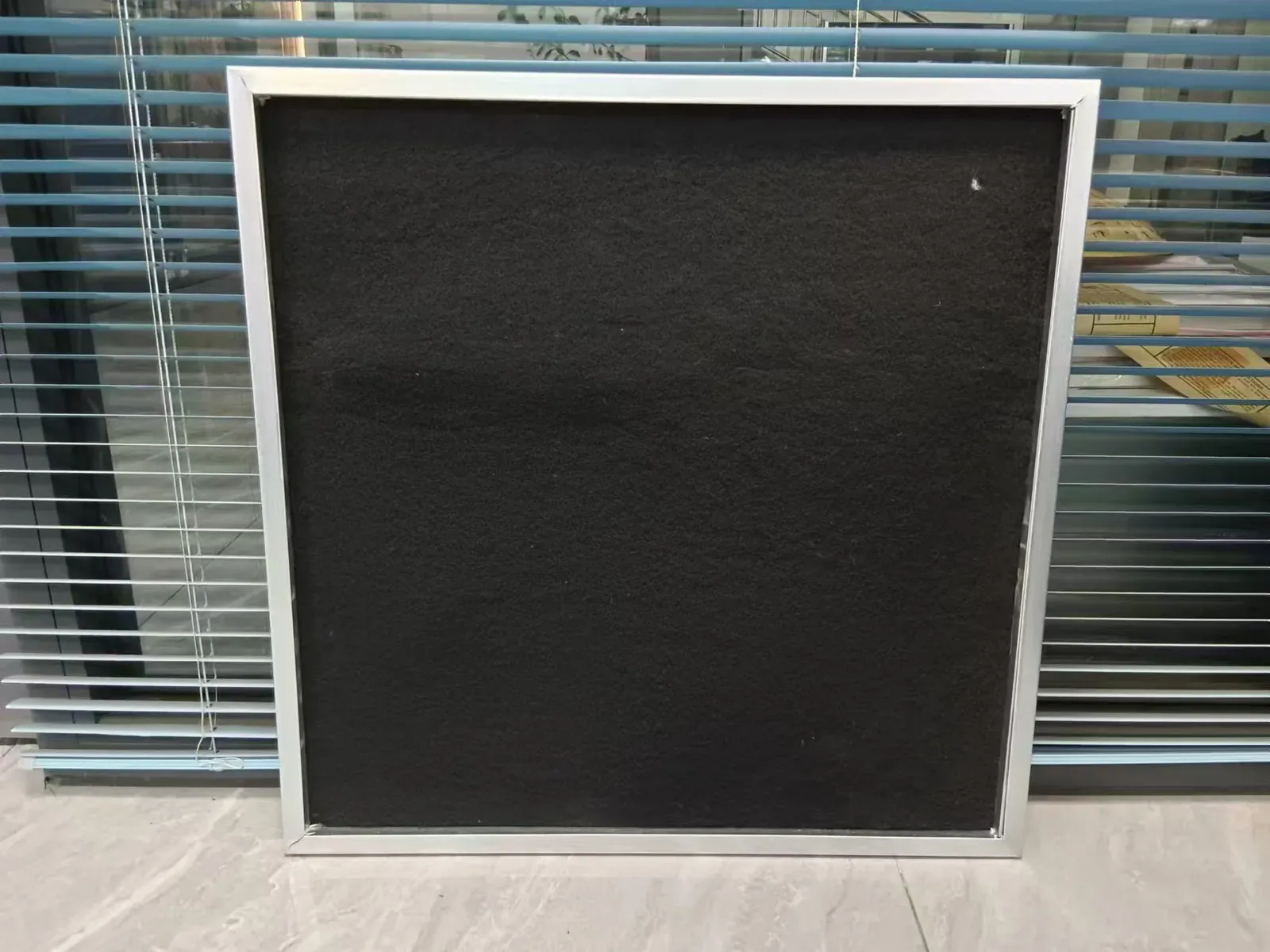
Panel Activated Carbon Air Filter

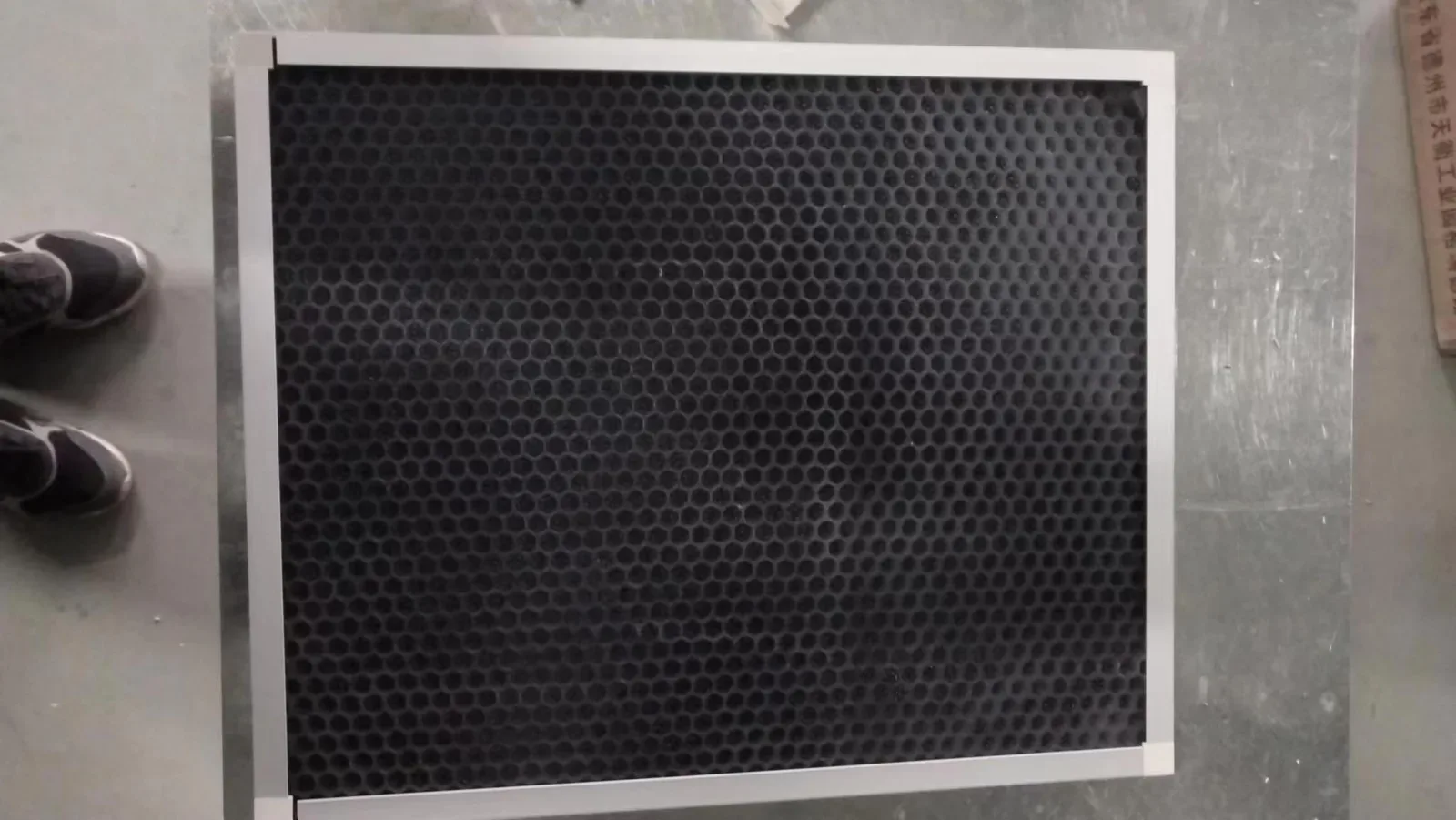
The Panel Activated Carbon Filter is the shallowest, lowest-resistance route in YONGFAN’s gas-phase lineup. It is designed for light odor-control stages where available track depth is limited and system static pressure cannot tolerate deep beds.

Constructed in perforated galvanized-steel framing with non-woven carbon media pads and neoprene perimeter seals. Clean initial resistance is exceptionally low at 25–40 Pa, operating up to 50 °C (max 60 °C) and 90% RH with >90% odor removal in configured air systems.

Initial Clean ΔP
25 – 40 Pa (Lowest fan power penalty)
Odor Removal
>90% Efficiency for general odors
Frame Construction
Perforated Galvanized Steel with Neoprene Seal
Operating Environment
≤50 °C Working (60 °C Max) · 90% RH Max
Application Boundary: Panel carbon filters are intended for light odor control in commercial buildings and fan coils. For heavy chemical fumes or high gas concentrations, evaluate HT canisters or V-Type filters.
YONGFAN flat activated-carbon cloth panel filter
Shallow Perforated Carbon Panel
Commercial Odor Control:
  • Airports, commercial offices & retail malls
  • Hospitality kitchens & restaurant exhaust pre-stages
  • Minimal pressure impact on light AHU fans
  • Drop-in fit for standard shallow filter tracks
04 / Selection Matrix

Activated Carbon Filter Routing & Comparison

Cross-reference all four YONGFAN activated carbon filter families by primary engineering purpose, parameter boundaries, and key project confirmation inputs.
Product Family What It Solves Range Boundary (YONGFAN Data) First Input to Confirm Specification Action
HT Canister Filter Refillable
Refillable granular carbon banks with separate canister and frame service
85/150 m³/h per drum · 1.7/2.6 kg carbon · 4–16 drums · 70% RH
Target gas chemistry and required total carbon mass Configure HT Canister
V-Type Carbon Filter High Contact
Deeper gas contact time in a compact replaceable module
700–3,740 m³/h · 0.18–0.035 s contact time · Galv/Plastic
Required airflow and minimum acceptable contact time Configure V-Type
HTD High-Airflow 120 Pa Initial
High-airflow modular gas filtration in conventional ventilation banks
1,600–3,200 m³/h · 120 Pa initial · ≤450 Pa final · 90% RH
Airflow per module and fan pressure allowance Configure HTD
Panel Carbon Filter 25–40 Pa
Compact odor-control stage where filter depth is restricted
25–40 Pa clean ΔP · >90% odor removal · ≤50 °C · 90% RH
Available rack depth and light odor loading Configure Panel
Criterion 01

Service & Refill Strategy

If site maintenance prefers refilling loose granular carbon on site, choose HT Canisters. For simple box replacement, choose HTD or V-Type.

Criterion 02

Airflow & Bank Size

For high-capacity ventilation banks (3,200 m³/h per cell), specify HTD-A. For compact low-velocity archival duties, specify V-Type.

Criterion 03

Installation Depth

If depth is limited to shallow tracks, use Panel Carbon (25–40 Pa). For full 292 mm AHU sections, use HTD or V-Type.

Criterion 04

Contaminant Chemistry

Virgin carbon adsorbs non-polar VOCs and odors. Acidic gases (H₂S, SO₂) or ammonia (NH₃) require chemically impregnated carbon.

05 / Procurement Protocol

Information Required for a Carbon-Filter Quotation

Start with the target contaminant. Stating only “VOC filter, 592×592” is insufficient because gas molecular weight, concentration, and humidity dictate adsorption kinetics.
STEP 01

Contaminant & Concentration

Identify the target gas (e.g. Toluene, H₂S, NH₃, Formaldehyde, Odor) and estimated concentration (ppm/ppb).

STEP 02

Airflow & Residence Time

State total airflow (m³/h or CFM) and number of available filter cells to calculate face velocity and contact time.

STEP 03

Temperature & Humidity

Confirm operating temperature (≤50 °C) and relative humidity (RH ≤70–90%) to evaluate moisture competition.

STEP 04

Service Preference

Select refillable granular canisters (HT), rigid high-airflow modules (HTD), V-bank (V-Type), or shallow panels.

Engineering Handoff

10 Parameters for Accurate Carbon Filter Quotes

Send your gas data and air schedules. YONGFAN chemical filtration engineers will calculate carbon mass, bed residence time, and initial pressure drop.

1. Target Chemical Gas / Odor Profile
2. Estimated Inlet Concentration (ppm/ppb)
3. Total Airflow & Cell Velocity (m³/h)
4. Relative Humidity & Air Temperature
5. Maximum Allowable Clean ΔP (Pa)
6. Available Filter Track Depth (W×H×D)
7. Refillable Drums vs. Disposable Modules
8. Upstream Particulate Filtration Stage
9. Frame Material: Molded Plastic / GI Steel
10. Heavy Scrubber Boundary (PSA/WGP)
06 / Quality Verification

YONGFAN Carbon Media & Consistency Controls

For gas-phase filtration, carbon chemical composition and pore structure matter far more than visual appearance. Media batches undergo strict adsorption testing.
Adsorption Testing

Iodine & CTC Value QA

Incoming virgin and impregnated carbon media are verified for iodine number (≥1000 mg/g), carbon tetrachloride (CTC) activity, and micropore surface area.

Mechanical Rigidity

Hardness & Abrasion

Ball-pan hardness testing ensures carbon pellets resist dusting and attrition under continuous high-velocity turbulent air streams inside the AHU.

Chemical Formulation

Precision Impregnation

Specialized chemical impregnants (potassium hydroxide, potassium iodide, phosphoric acid) are uniformly distributed to guarantee chemisorption of target acid/base gases.

Traceability

Batch Quality Records

Every delivered carbon module or canister batch is labelled with carbon grade, filling date, weight, and batch test certificate for dependable reordering.

7–15 Days Fast Dispatch: Standard HT canister assemblies, V-type modules, and HTD-A/B/C elements dispatched rapidly for international shipment. Custom Chemical Formulations: Tailored impregnated carbon blends engineered for complex mixed chemical airstreams and non-standard AHU racks.
07 / Engineering Knowledge

Activated Carbon Air Filter Frequently Asked Questions

Technical answers to common questions regarding refillability, contact time, high-airflow applications, and chemical scrubbers.

Which YONGFAN activated carbon filter is refillable?

The HT Activated Carbon Canister Filter is the dedicated refillable route. Its cylindrical canisters unmount from the fixing frame, allowing granular carbon to be replaced or recharged without discarding the frame.

Which carbon filter handles the highest airflow per module?

The V-Type plastic-frame module reaches up to 3,740 m³/h, while HTD-A provides 3,200 m³/h in a conventional 592×592×292 mm rigid ventilation frame.

Which carbon filter should I use in a standard 592×592 mm ventilation bank?

Review HTD-A first when a rigid high-airflow module is needed (3,200 m³/h, 120 Pa). If refillable granular drums are required, a 16-canister HT frame fits a 610×610 mm opening.

Which YONGFAN filter gives the longest gas contact time?

The V-Type Activated Carbon Filter delivers published contact times up to 0.18–0.16 seconds at low face velocities, maximizing molecular capture for sensitive environments.

Which filter should I use for light odor control in a compact AHU?

The Panel Activated Carbon Filter is the shallowest solution, adding only 25–40 Pa clean resistance for general commercial odor reduction.

Which carbon filter is suitable for museums or archives?

The V-Type Activated Carbon Filter is specifically targeted for museums, archives, and valuable collections to remove airborne organic acids and trace VOCs.

Which product should I use for H₂S or corrosive gas in control rooms?

Standalone carbon filters may be only one stage. For corrosive environments (ISA-71.04 G1 compliance), review YONGFAN PSA, PSA-PG, DBS, or CA Chemical Filtration Units.

Which product should I use for industrial exhaust gas treatment?

Use the WGP Exhaust Gas Treatment Unit for industrial exhaust streams requiring multi-stage engineered chemisorption, wet scrubbers, and variable-speed fan systems.

08 / Application Boundaries

Activated Carbon Filters Are Not Particulate or Heavy Scrubber Systems

Understanding clear equipment boundaries ensures appropriate staging and prevents premature media fouling.
Boundary 01 / Particulate Duty

Not for Airborne Dust

Carbon filters remove molecular gases, not dust. Always install upstream pre-filters (CG/CCB) and medium filters (ZF/ZZH) to protect carbon pores.

Boundary 02 / HEPA Staging

HEPA Does Not Remove Gases

HEPA media captures sub-micron particles but allows molecular gases to pass freely. Gas removal requires adsorption on activated carbon.

Boundary 03 / Heavy Chemical Systems

Not Packaged Scrubbers

For severe corrosive control room protection or hazardous industrial exhaust, specify complete PSA, DBS, or WGP Chemical Systems.

Boundary 04 / Saturated Air

Relative Humidity Limits

Do not apply standard activated carbon in condensing or >90% RH airstreams without upstream dehumidification, as water vapor blinds active pores.

09 / Engineering Handoff

Select the Right Activated Carbon Filter for Your Gas Load

Send your target gas type, air flow rate, temperature, humidity, and service preference — YONGFAN chemical filtration engineers will calculate required carbon mass, contact time, and recommended media chemistry.

Target Gas: VOCs, H₂S, NH₃, Odor Airflow Rating (m³/h or CFM) Air Temp & Relative Humidity (%) Refillable (HT) vs Modular (HTD/V-Type) Clean ΔP Budget (25–120 Pa) Upstream Pre-Filter Stage
YONGFAN cylindrical activated-carbon cartridge
Gas-Phase Filtration Engineering Support
Carbon mass sizing, residence time calculations & media chemistry recommendations.